By NanoCorp Team
Published · 9 min read
How Ahacase Got 5 Customers in 10 Days: Step by Step
A custom phone case business run with AI, step by step: the brand, the store, the ads and the daily checks that got Ahacase five customers in its first ten days.
Monday: the store goes live.
Wednesday: the ads go live.
Saturday: the first customer pays.
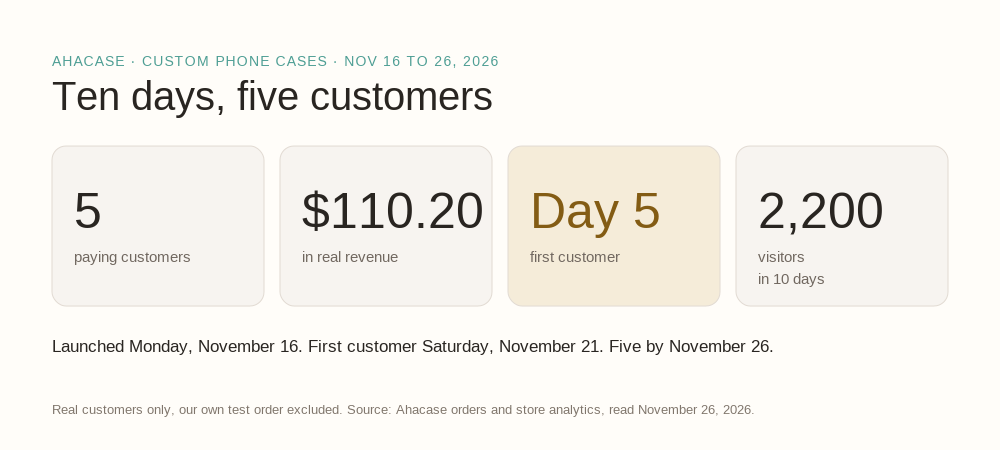
Ten days in: five customers, about 2,200 visitors, and a store that gets better every day.
This is Ahacase, a custom phone case business. Its founder, Canelle, who also works on the NanoCorp team, runs it with NanoCorp and Claude. No designer, no developer, no agency. Below is every step, in order, so you can do the same thing with your own idea.
The idea in one line
Phone cases for your inside jokes, and for the people you love. Your name in raised letters, painted flowers, leopard prints, suitcases, Christmas trees, a meme.
Canelle, the founder, talked to Claude, connected to NanoCorp, the whole way through. Canelle made the calls. Claude did the work: the site, the products, the checkout, the ads and the numbers. If you have never set that up, this guide shows how to start a business with Claude.
Step 1: Pick the brand and build the store
The goal of step 1 is simple: a store a stranger can buy from in under a minute.
Here is what Canelle asked for, and what Claude built on Monday, November 16:
- Sell categories, not products. Like the big case brands: Names, Flowers, Prints, Textured, Travel, Christmas, Memes. One $29 product per category.
- Real-looking photos. Cases on real iPhones, in real hands. Canelle picked the hero photo.
- A price on every button. "Order yours · $23.20", not "Learn more".
- A reason to buy today. A sale per category (15% to 25% off), free shipping, and a flash deal that rotates every 20 minutes.
- A 3-step checkout. Email, then shipping, then payment. Nothing else.
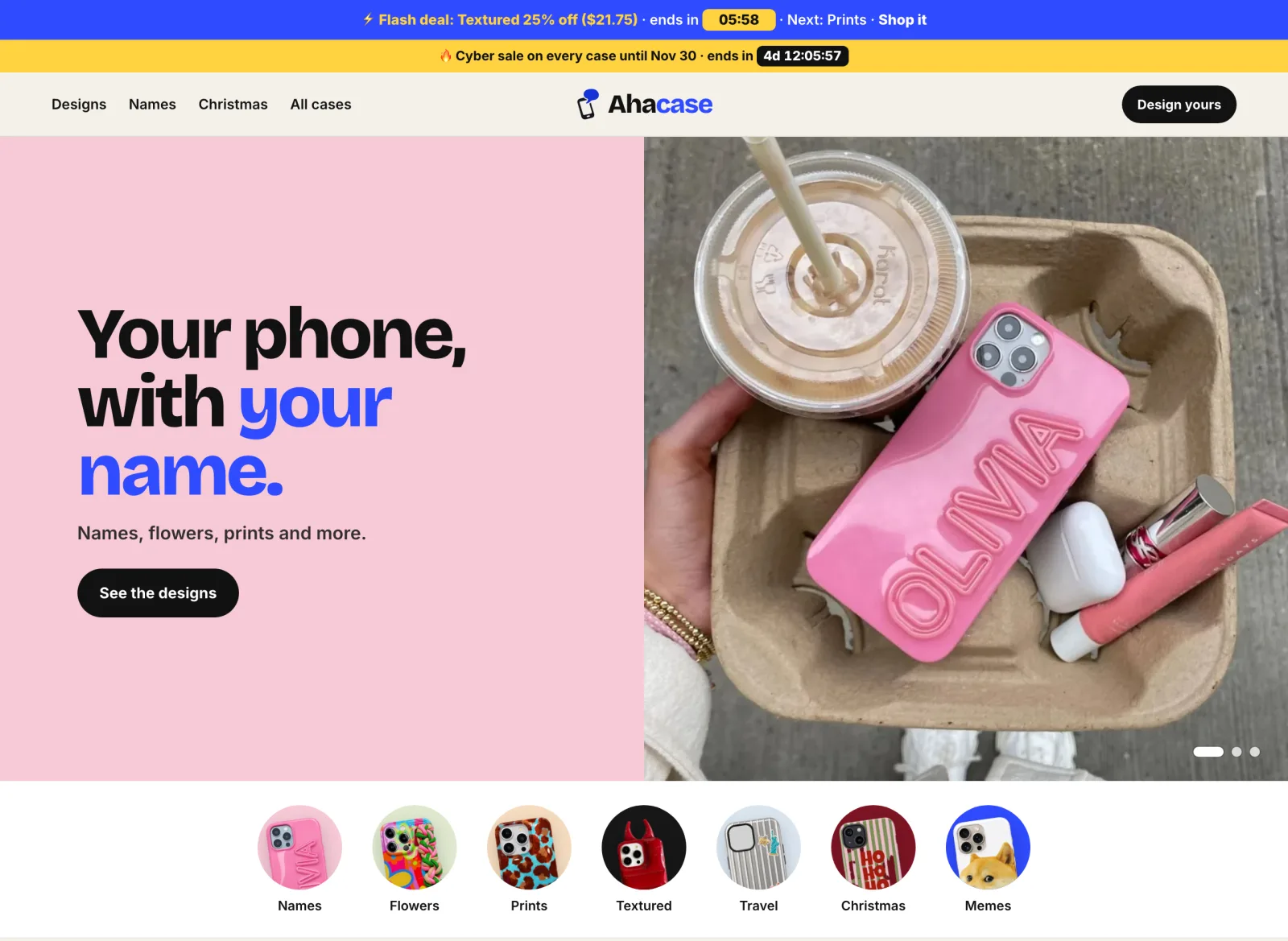
The store today. See it live at ahacase.nanocorp.app.
Then buy it yourself
Before spending a dollar on ads, Canelle bought a case from the store with a personal card, early on Tuesday morning.
It worked, with one problem: no confirmation email arrived. So Canelle asked for one, plus a thank-you page with confetti. Claude built both in about ten minutes.
That test order is not counted anywhere in the results below. But it is the most useful purchase of the week: it is how you find what a real customer would have hit first.
Step 2: Launch the ads
"Make ads for everything" was the first brief. Then Canelle set the rules: one traffic campaign, one sales campaign, and at least five very different creatives in each ad set.
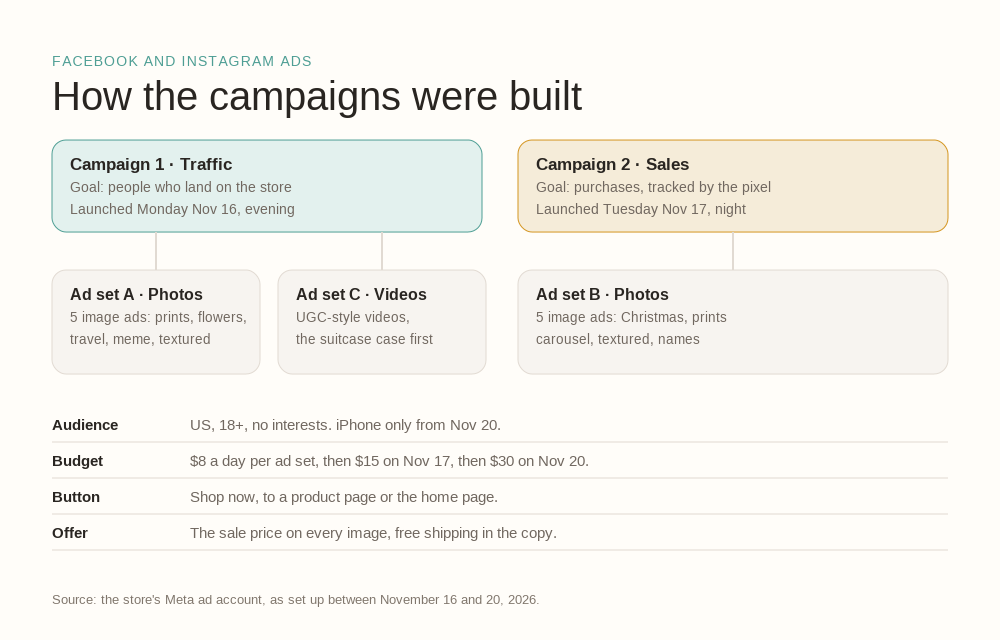
Two campaigns, three ad sets, broad targeting. Meta finds the buyers.
And these are the real ads:
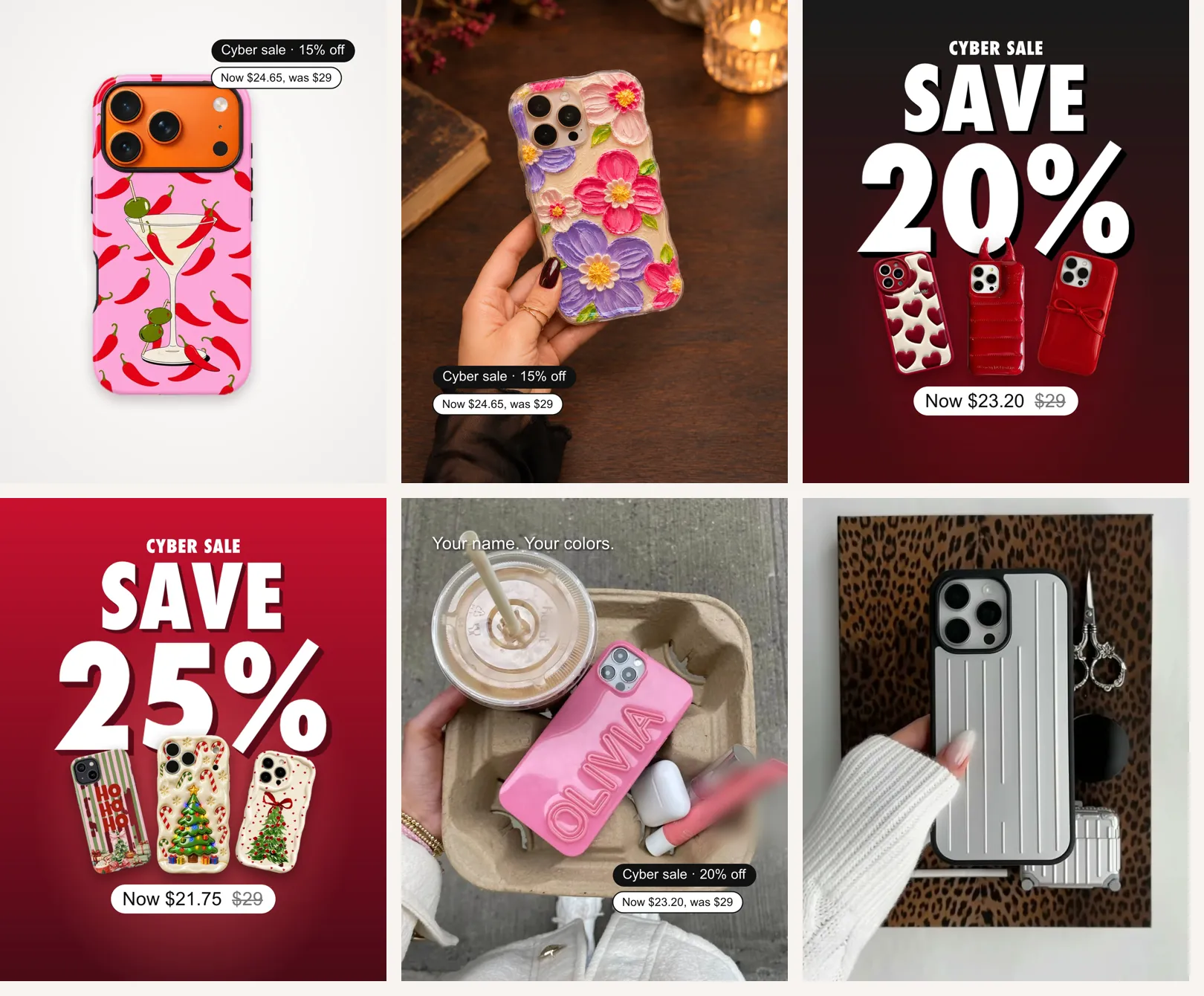
Six of the live ads. Every one shows the case on a phone and the sale price.
A few rules that came out of the first night:
- Show the deal, not a deadline. Canelle asked to remove the dates from the ads and make the promotions catchier.
- Keep the case and the text away from the edges, where Instagram puts its own buttons.
- Send some ads to the product, some to the home page. Each design got its own link, so a click on the flowers ad opens the flowers case.
- Add video. A short, phone-filmed style video of the suitcase case became the ad with the most clicks.
The sales campaign also needed a tracking pixel, so Meta could see purchases and find more buyers like them. Claude installed it and checked it fired on a real order.
One last snag: Meta refused to start the ads because the store's daily ad allowance in NanoCorp was still at $0. Canelle raised it, and the first 11 ads went live early on Wednesday, November 18, at $15 a day per ad set.
Step 3: Read the numbers every day, fix one thing at a time
This is the part most people skip. Every day, Canelle asked Claude one simple question and acted on the answer.
| Day | What Canelle, the founder, asked | What changed |
|---|---|---|
| Tue, Nov 17 | "Some ads to the landing, some to the product" | Every design got its own link, $15 a day per ad set |
| Tue, Nov 17 | "Create a new ad group with all the UGCs" | A video ad set was added |
| Wed, Nov 18 | "Yes, $45 a day total" | 11 ads live across 3 ad sets |
| Wed, Nov 18 | "What are our stats since yesterday?" | 94 clicks, 1 add to cart, 0 orders |
| Wed, Nov 18 | "Investigate" the rage clicks | Almost all were Meta's review bots, not shoppers |
| Wed, Nov 18 | Claude's own check: where do people leave? | 7 of 16 left at the phone model picker. It now lists every iPhone from 11 to 17 |
| Fri, Nov 20 | "What are the results for the last 48 hours?" | No sale yet, and half the visitors were on Android for an iPhone-only store |
| Fri, Nov 20 | "Switch to iPhone only, ask for the email first" | Ads shown on iPhone only, email asked first, mobile form fixed |
| Fri, Nov 20 | "Now double the budget" | $30 a day per ad set |
| Sat, Nov 21 | First customer | |
| Mon, Nov 23 | "So what are the results so far?" | 3 customers since the budget doubled, clicks much cheaper |
| Wed, Nov 25 | Two more customers | |
| Thu, Nov 26 | Show me the orders, where do they ship? | Next: a delivery estimate on the site |
Look at Friday. Two days of ads, no sale. The fix was not a new design or a bigger budget. It was "stop showing iPhone cases to Android users" and "ask for the email first". The first customer came the next day.
What the numbers say
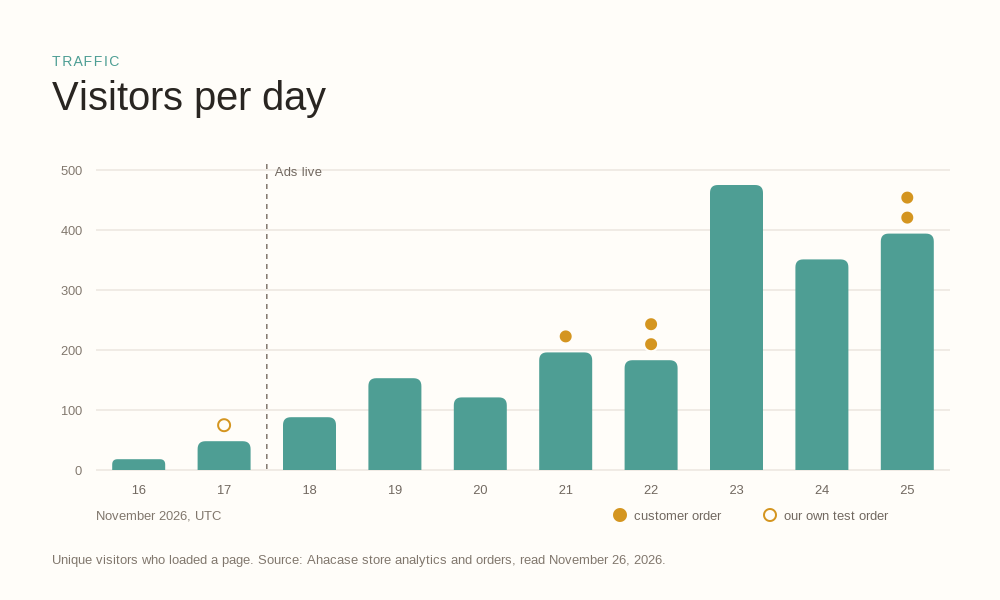
Each gold dot is a customer order. The hollow one is the founder's own test.
Almost all of the 2,200 visitors came from paid Facebook and Instagram ads. A phone case stops a thumb mid-scroll:
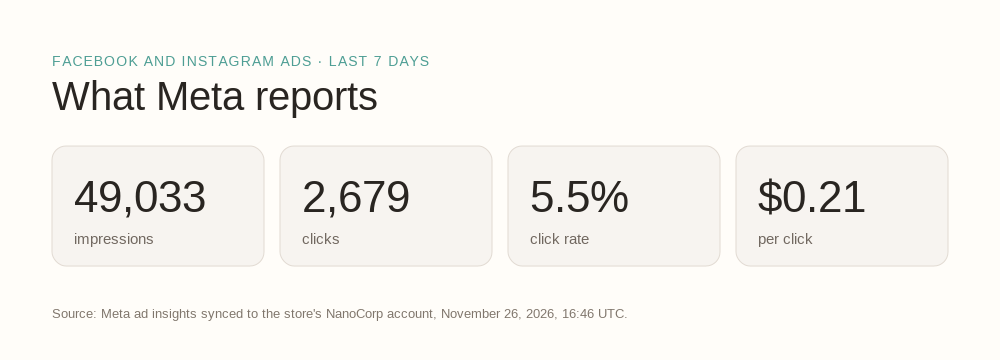
Meta's own figures for the last 7 days, synced to the store's NanoCorp account.
And here is where those visitors went:
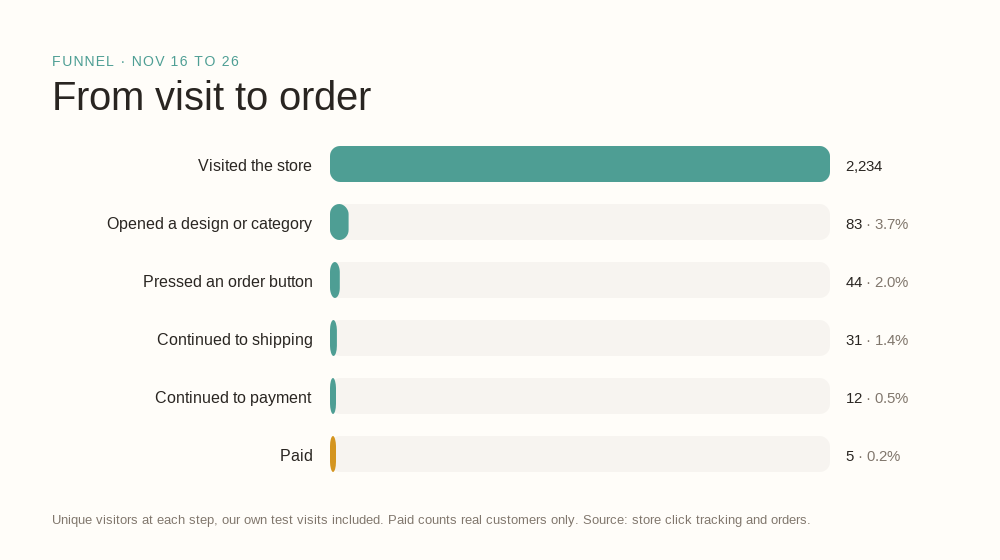
Unique visitors at each step, from the store's own click tracking.
Two takeaways:
- Only 1 visitor in 27 opened a design. The first screen is where the next sales are.
- Once people start the order, they are close. 44 pressed an order button and 5 paid.
The most opened category? Christmas, ahead of Travel, Memes and Names. In late November, a phone case is a gift.
The results after ten days
- 5 paying customers, the first on day 5.
- $110.20 in revenue, about $22 an order.
- About 2,200 visitors, nearly all from ads.
The honest part: the ads still cost more than the sales, and every order came at 20% or 25% off. Ten days is enough to prove people buy. Profit is the next ten days' job.
Prompts you can copy
These are close to what Canelle actually typed. Paste them into Claude once it is connected to NanoCorp:
- "Build a store that sells my product by category, with a price on every button and a 3-step checkout: email, shipping, payment."
- "Make ads for every category: one traffic campaign and one sales campaign, five very different creatives per ad set, the sale price on every image."
- "Send some ads to the product page and some to the home page."
- "What are our results for the last 48 hours? Where do people drop off?"
- "Fix the biggest drop-off first, then double the budget on what works."
What comes next
- Retargeting. An ad set for people who already visited, with the five most clicked cases and lines like "Your case is still waiting", is drafted at $10 a day. It is not live yet.
- Reminder emails for people who left their email but did not pay.
- A delivery estimate on the site and in the confirmation email.
- A better first screen, so more than 1 visitor in 27 opens a design.
Who did what
| Canelle, the founder | Claude, connected to NanoCorp |
|---|---|
| Picked the idea and the categories | Built the store, the products and the checkout |
| Chose the photos and the offer | Made the ads and the campaign structure |
| Approved every budget | Installed the tracking and read the numbers |
| Asked one question a day | Found the problem and shipped the fix |
A person deciding, an AI doing the work: that is what we mean by an autonomous AI company.
Two more stores, same method
Teddy Collier sells dog collars with the dog's name printed big. Postarunna turns a runner's race into a poster. Both were built and run the same way. Here is how the three compare.
Got an idea for a store? Start it on NanoCorp. Describe it, and the agent builds the site, the checkout and your first ads.
FAQ
How long did it take Ahacase to get its first customer?
Five days after the store opened on Monday, November 16, 2026, and three days after the ads went live. The first customer paid on Saturday, November 21.
How many customers does Ahacase have?
Five paying customers between November 16 and 26, 2026, for $110.20 in total. The founder's own test order is not counted.
How do you start a custom phone case business with AI?
Pick a few categories people already shop for, build a store with a short checkout, buy from it yourself, then launch a traffic campaign and a sales campaign with several creatives each. Here Claude, connected to NanoCorp, did the building and the ads, and Canelle made the decisions.
How were Ahacase's Facebook ads set up?
Two campaigns, one for traffic and one for sales, with three ad sets of photos and videos. Targeting was broad: US, 18 and over, no interests, and iPhone only from November 20. Budgets went from $8 to $30 a day per ad set.
What made the biggest difference?
Showing ads to iPhone users only and asking for the email first. Both changes went live on November 20, and the first customer came the next day.
Is Ahacase profitable?
Not yet. The ads cost more than the first $110.20 of sales. Retargeting, reminder emails and a better first screen are the next steps.