By NanoCorp Team
Published · 7 min read
How Teddy Collier Sells Name Collars With AI: Step by Step
How to sell custom dog collars online with AI, step by step: the store built in 33 minutes, five ad tests in six days, the daily check, and the email and video that found the first customers.
A dog. A collar. The dog's name, printed big.
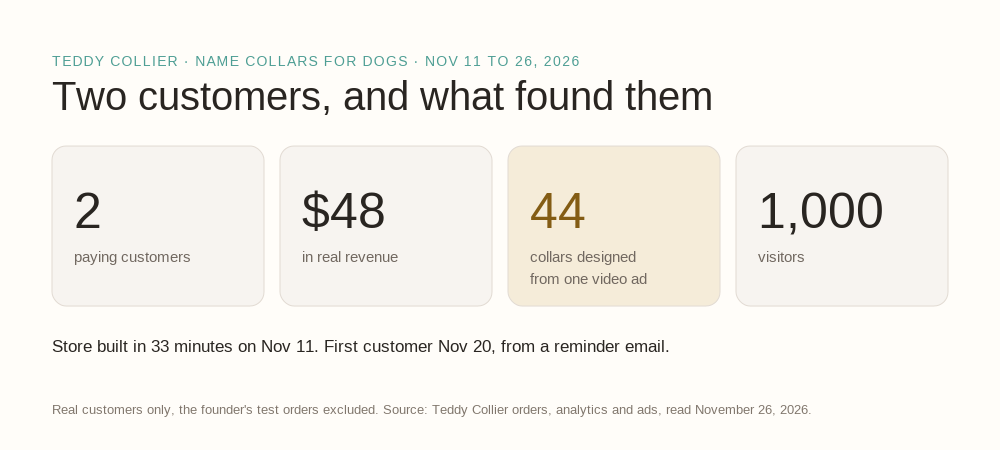
That is the whole idea behind Teddy Collier, a store that sells custom dog collars online, built and run with NanoCorp by its founder, PLB, who also works on the NanoCorp team. The store was live 33 minutes after PLB described it. The first customer came from a reminder email. The second came from a short video of a dog called Biscuit.
Here is every step, so you can copy what worked and skip what didn't.
Step 1: Describe the idea, get a store
On November 11, PLB, the founder, answered NanoCorp's founding interview in about eleven minutes. The brief, close to word for word: sell custom dog collars, a simple shop, a classic launch with Meta ads, aimed at dog owners. Brand words: bold, wild, devoted. Never cutesy, never snobbish.
Then PLB asked for the one feature that makes the product: "They can put the name of their pet on the collar. They need to see a preview before they can buy it."
The agent built the store, the logo and the preview in 33 minutes. Before selling anything, it also checked the numbers with the print supplier: about $22 to make and ship a collar sold at $29. A thin margin, and a reason to keep the offer simple.
Step 2: Make the product look like the product
The first images did not show the real colors or a real name on a real dog. PLB said so, bluntly: "You can do way better." The agent regenerated them from the actual collar designs and added a loading spinner while each preview is made.
Then came three days of tightening:
- "Simplify, simplify, simplify." Disclaimers removed, one approval button, address autofill.
- The name had to fit. Short and long names were tested until none hid behind the buckle.
- One product instead of twelve. Four patterns in three sizes became one Name Collar in five colors, under a new name: Teddy Collier, at teddycollier.com.
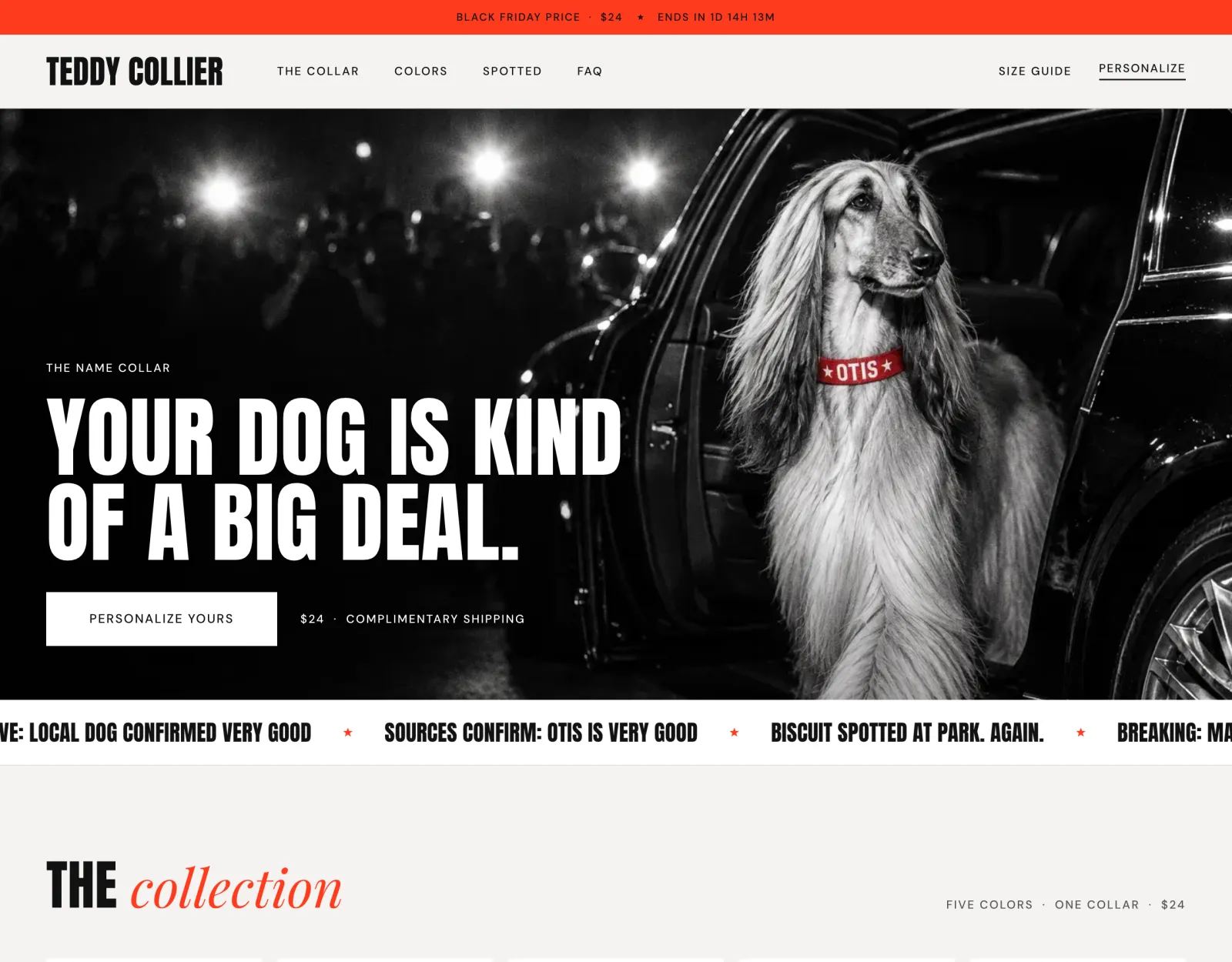
The store today. See it live at teddycollier.com.
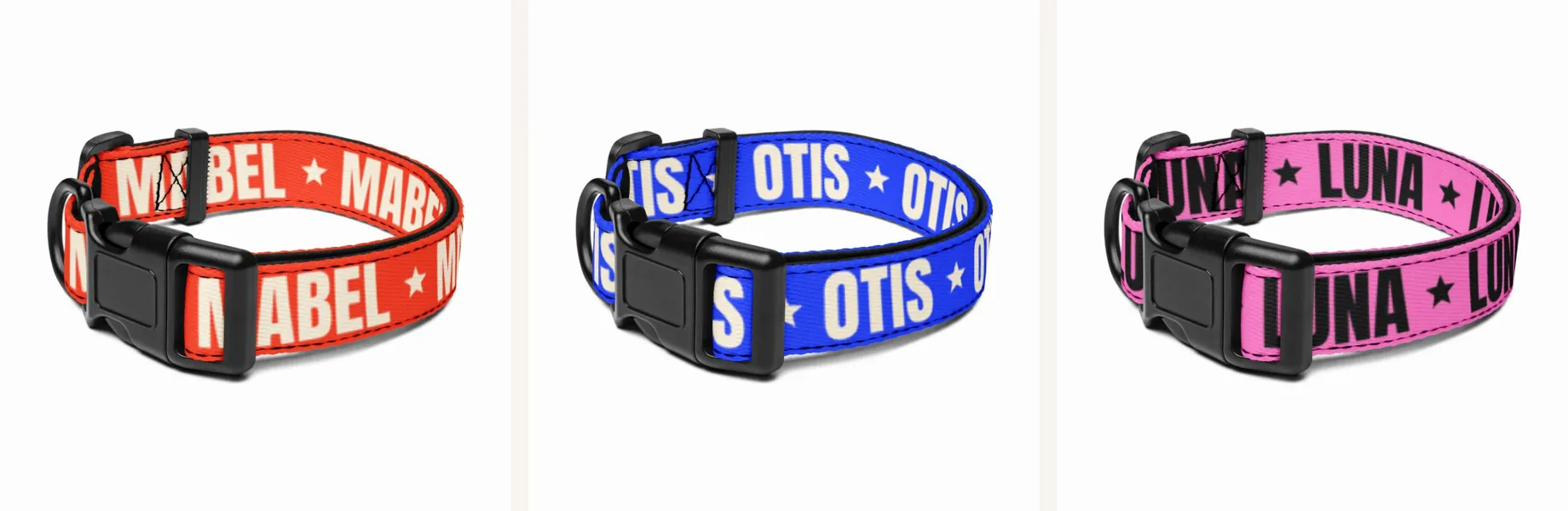
One collar, five colors, the name printed big between stars.
Then buy it yourself
PLB placed test orders before and right after the first ads. They are not counted in the results. They proved that a real order reaches the printer and sends a confirmation.
Step 3: Test ads fast, stop what doesn't work
The ads ran as a series of small tests, each about $28 a day, each with one question to answer.
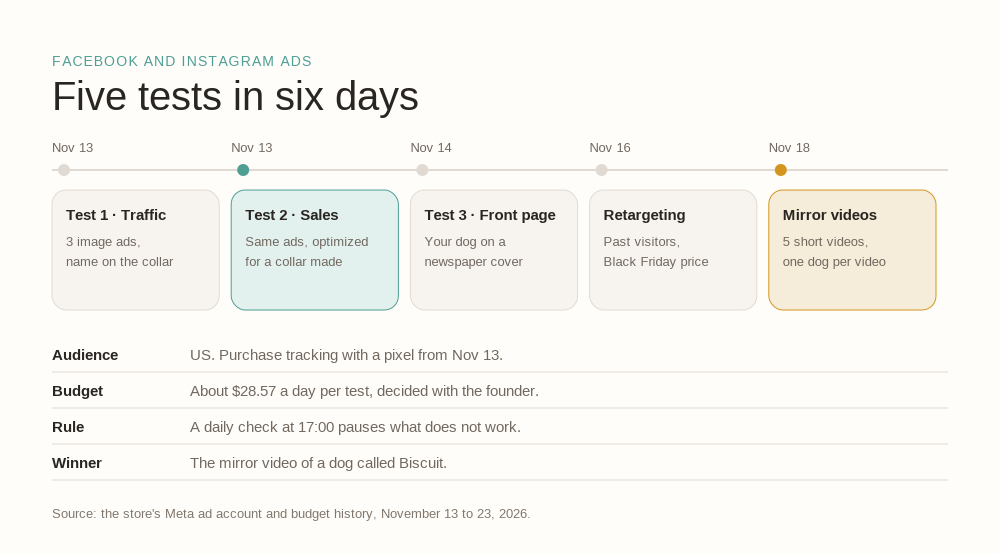
Five tests in six days. Every one had a stop rule.
The rule that made this work was set up on day 3: a check every day at 17:00 that pauses what doesn't work. Three stop rules:
- An ad spends $15 with nobody starting a collar: pause it.
- The sales ads bring 200 visits with no checkout: stop and rethink.
- Retargeting spends $10 with nobody making a collar: pause it.
Rule 3 fired. The retargeting ad, shown to people who had visited, designed a collar or reached payment in the last 30 days, reached about 1,100 people and brought 45 visits. Nobody designed a collar, so it was paused on November 18. A cheap answer, and a useful one.
Step 4: Ask one question a day
| Day | What PLB, the founder, asked | What changed |
|---|---|---|
| Fri, Nov 13 | "How are the ads doing? Any sales?" | No sale yet. Per-ad tracking added: visits, names typed, sizes picked, collars made |
| Sun, Nov 15 | "How are the ads performing?" | The newspaper-cover ads were fun but sent 2 clicks to the collar. Stopped |
| Mon, Nov 16 | "Any sales?" | Not yet. A $24 Black Friday price, a one-page checkout and a retargeting test |
| Tue, Nov 17 | A reminder email to everyone who had designed a collar | |
| Wed, Nov 18 | Mirror videos launched. A "your collar is still waiting" email to 7 people who stopped at payment | |
| Thu, Nov 19 | "I want to double the daily ad spend" | The agent warned: no sale from an ad yet, so doubling would double the drop-offs |
| Fri, Nov 20 | First customer, from the "still waiting" email | |
| Sun, Nov 22 | "Any sales?" | One customer so far, and ad credits about to run out. That afternoon: second customer, from the Biscuit video |
What made the difference
The image ads got clicks. The video got collars.
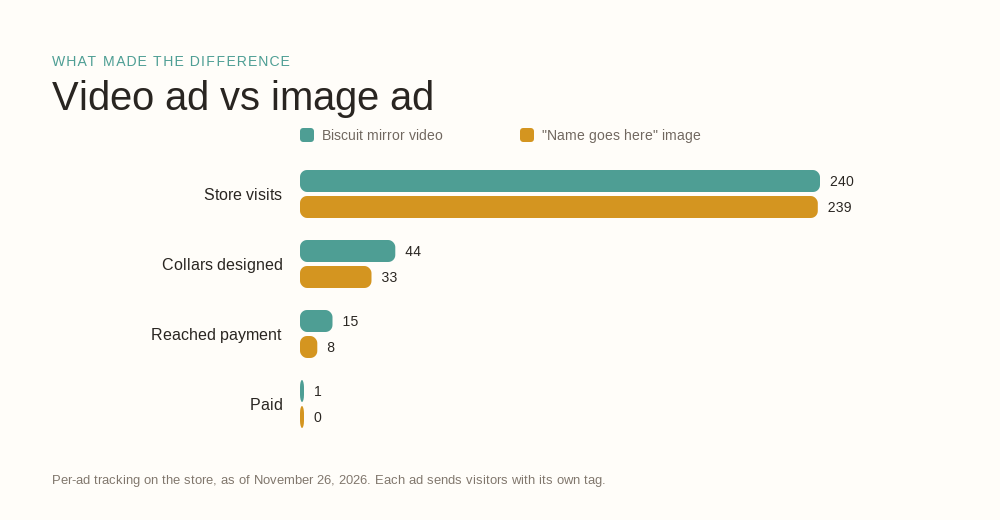
Same number of visitors, very different intent. Each ad sends visitors with its own tag.
The mirror video shows a dog looking at itself, its name on the collar. It brought 44 collars designed and 15 people to payment from 240 visits. That is the ad to scale.
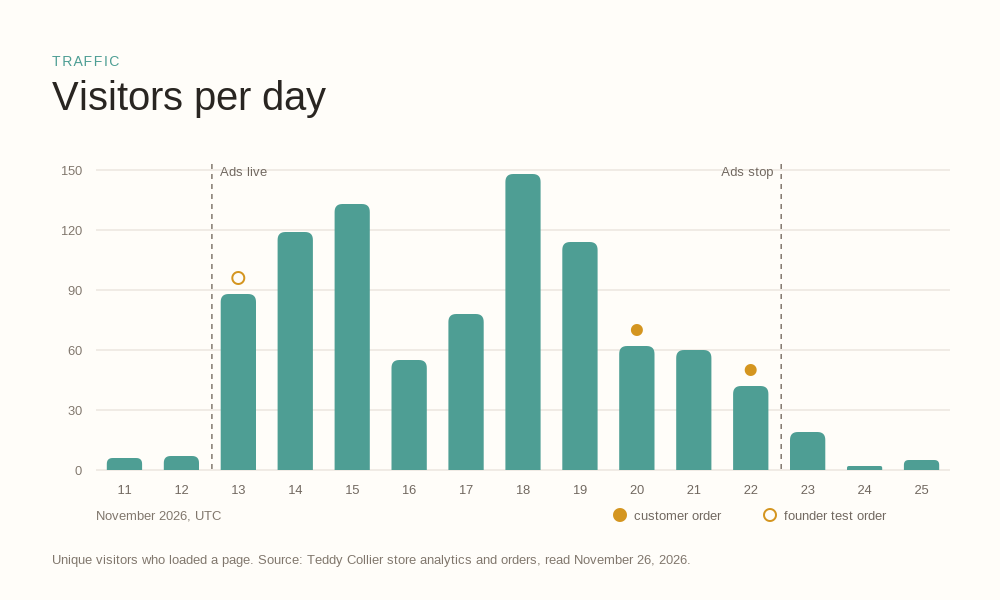
Traffic follows the ads. On November 23 the account ran out of ad credits, and visits fell to a few a day.
The results after two weeks
- 2 paying customers, both at the $24 Black Friday price.
- $48 in revenue.
- About 1,000 visitors, nearly all from Facebook and Instagram ads.
- One clear winner: the Biscuit mirror video.
The honest part: the ads cost far more than the sales, and the margin on a $24 collar is thin. The store proved that people design collars. The next step is getting them to pay.
Prompts you can copy
- "Build a store where customers type their pet's name and see a preview before they buy."
- "Check the supplier cost and shipping before we set the price."
- "Run small ad tests, about $30 a day each, and track every ad separately: visits, names typed, collars made, payment."
- "Every day at 17:00, pause any ad that spent $15 with nobody starting a collar."
- "Email everyone who designed a collar but didn't pay."
What comes next
- Restart the ads on the Biscuit video only, once credits are topped up.
- Offer two collars for gifts, so each sale covers more of the ad cost.
- Fix the step between payment page and paying, where 15 people stopped for 1 who paid.
Two more stores, same method
Ahacase sells custom phone cases and got five customers in its first ten days. Postarunna turns a runner's race into a print for the wall. Here is how the three compare.
Read more on what an autonomous AI company is, or start your own store on NanoCorp.
FAQ
How do you sell custom dog collars online with AI?
Describe the product, ask for a live preview of the dog's name on the collar, check the supplier cost, then test small ads with a daily stop rule. Here the NanoCorp agent built the store in 33 minutes and ran the tests. PLB, the founder, made the decisions.
How many customers does Teddy Collier have?
Two paying customers between November 11 and 26, 2026, for $48. The founder's own test orders are not counted.
Where did the first customers come from?
The first came from a "your collar is still waiting" email sent to people who stopped at payment. The second came from a short mirror video ad of a dog called Biscuit.
Did retargeting work for Teddy Collier?
Not this time. It reached about 1,100 past visitors and brought 45 visits, but nobody designed a collar, so the daily check paused it after $10.
What was the best ad?
The Biscuit mirror video. It brought 44 collars designed and 15 people to payment from 240 visits, against 33 and 8 for the best image ad.
Is Teddy Collier profitable?
Not yet. The ads cost more than the sales, and they stopped on November 23 when the ad credits ran out.