By NanoCorp Team
Published · 8 min read
How Postarunna Sells Marathon Route Posters: Step by Step
A marathon route poster store built and run with AI, step by step: the screenshot reader, the ad that won, the agent that checks the store every three hours, and the change before the first sale.
3:58:12. A marathon finish time, printed big, above the route you ran.
That is Postarunna: a marathon route poster made from one Strava screenshot, framed or unframed, for your wall. Its founder, Pierre, who also works on the NanoCorp team, built it with NanoCorp and let the agent run it. It is the hardest of our stores to sell: thousands of people clicked the ads, and almost nobody uploaded a screenshot. This is how the agent found the problem, step by step.
Step 1: Find the gap before you build
On the evening of November 10, Pierre, the founder, described the idea in the founding interview: a framed print of a runner's race, sold as a gift on Instagram, made from a Strava screenshot with a live preview before checkout.
Before writing a line of code, the agent searched the market. It found about 15 Strava print apps and plenty of print shops. Most of them need a Strava login or a GPX file. That became the promise: one screenshot, no account, no Strava login, see it before you pay.
The brand came from three words Pierre picked: bold, athletic, electric. Color: orange. And a rule worth stealing: no countdowns, no fake urgency.
Step 2: Build the hard part first
The product only works if the screenshot reader works. So that came first:
- A screenshot becomes a print preview. The first version traced the route from the image pixels. It picked up orange buttons instead of the route. Pierre: "it didn't work".
- Switch to a vision model. On November 12 the agent rebuilt the reader to read the route, the time and the distance from the screenshot, and tested it on Pierre's own run.
- Wire the printing. An end-to-end test order went through the print supplier with a confirmation email, before any ad ran.
- Make the order one screen. Proof approval removed, one form and one button.
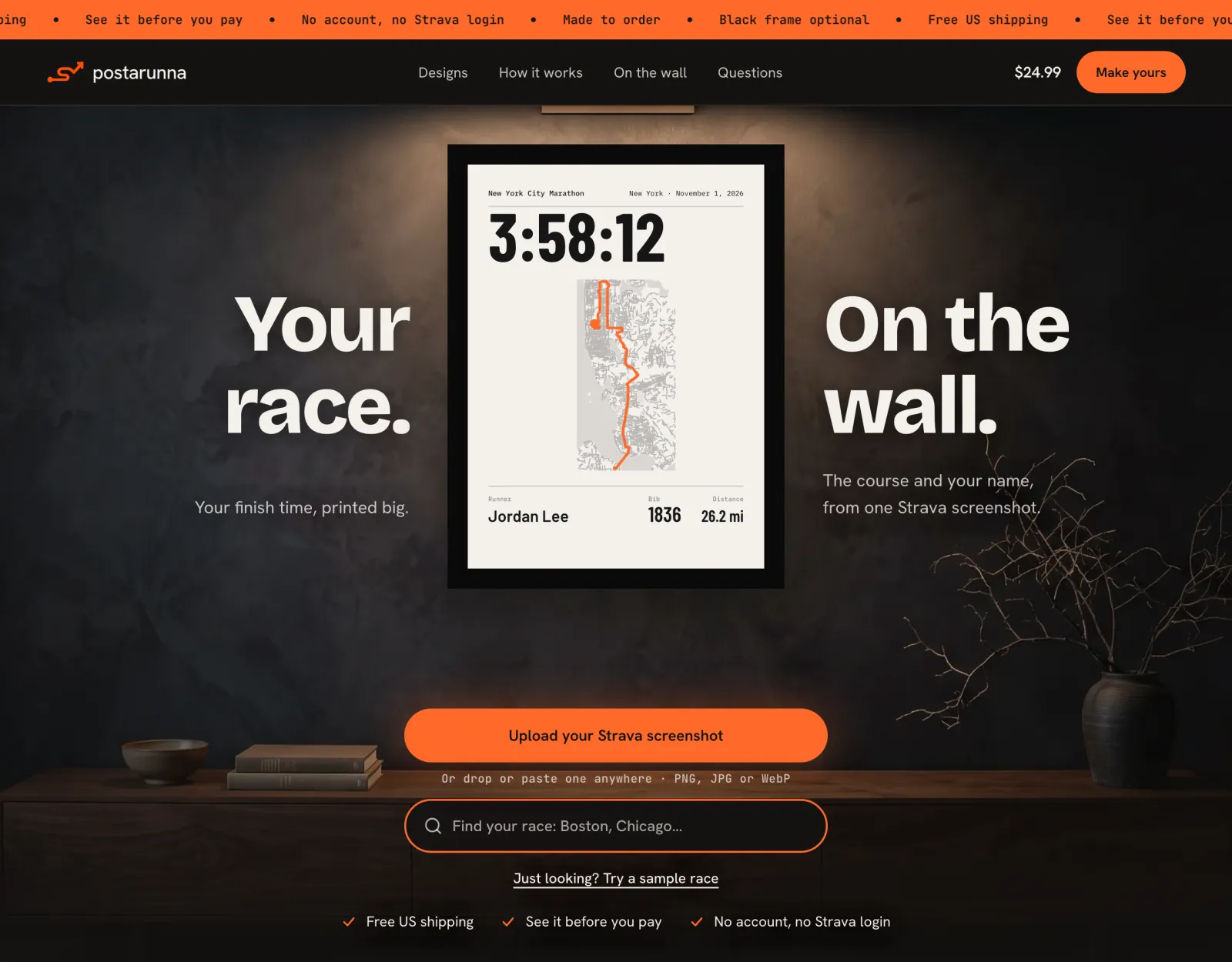
The store today. See it live at postarunna.com.
The price moved as the agent learned: $79 at first, then $59, then a cheaper unframed print at $24.99 next to the framed one at $59.99.
Step 3: Launch the ads, then let one ad win
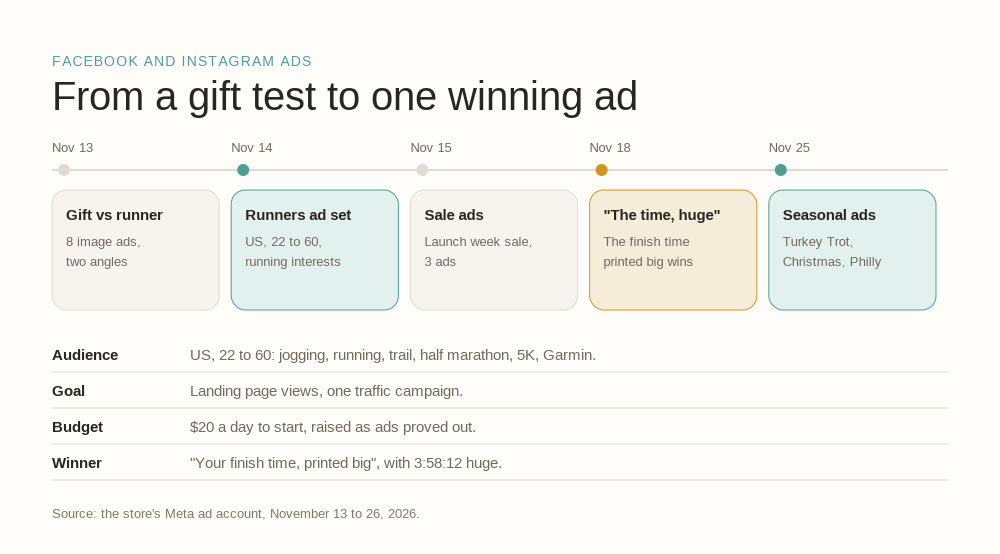
One traffic campaign aimed at runners, a new angle every few days.
The first test pitted gift ads against runner ads. A gift ad about a bib forgotten in a drawer got almost all the clicks. But Pierre asked the right question on day 2: "Do people generate posters??" The answer was no. Zero uploads. Gift buyers don't have the runner's screenshot.
So the ads moved to runners themselves: US, 22 to 60, interested in running, jogging, trail, half marathons, 5Ks and Garmin. And one ad took over: "Your finish time, printed big."
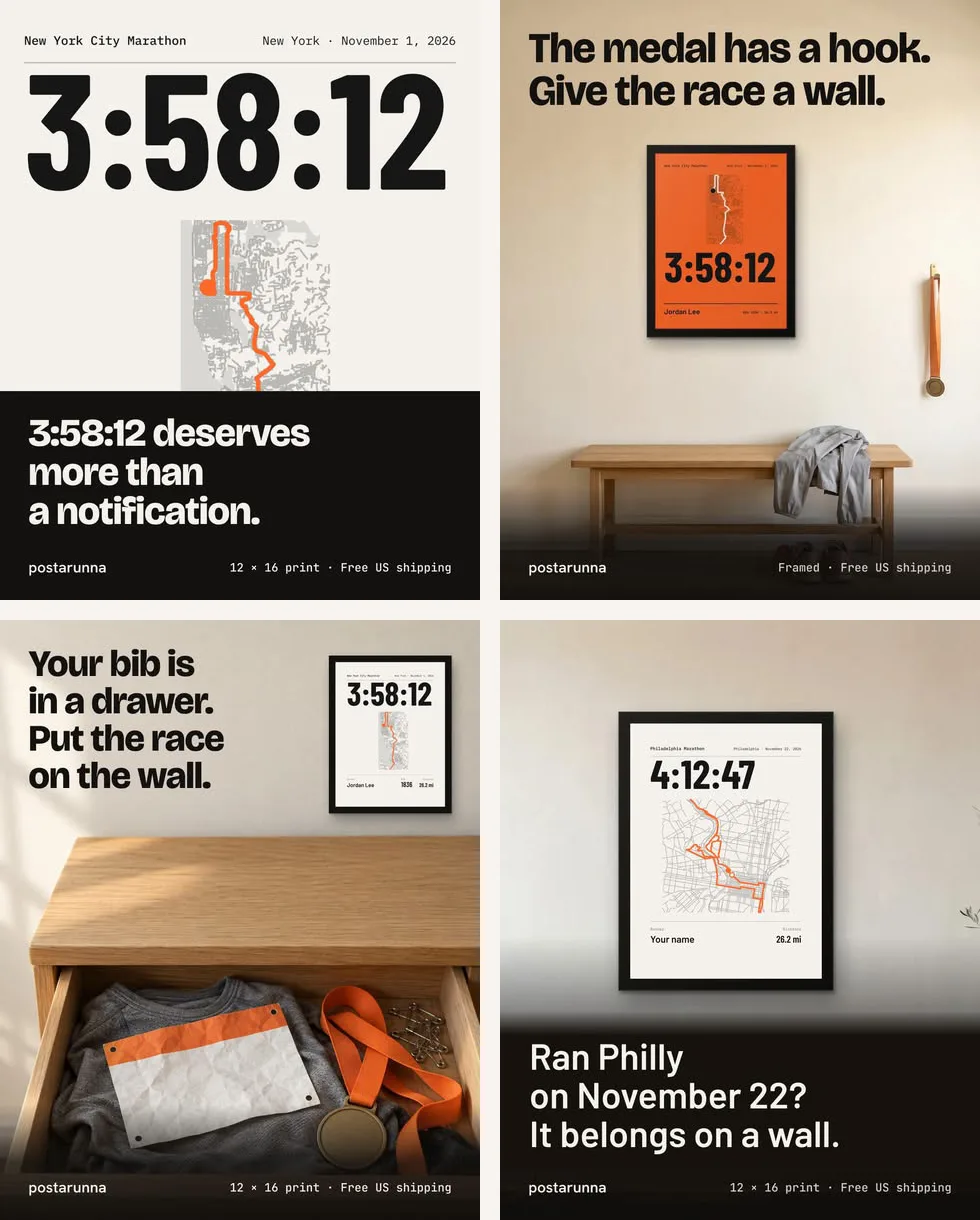
Four of the real ads. Top left is the winner.
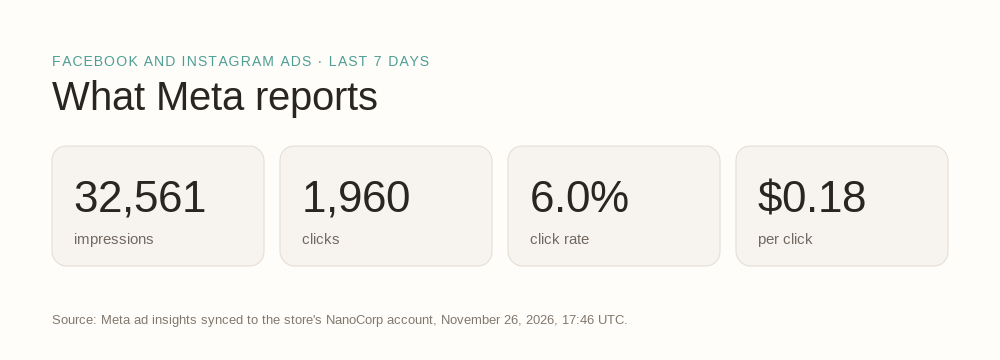
Meta's own figures for the last 7 days. Cheap, eager clicks.
Then, in the last week of November, the agent added seasonal ads: Turkey Trot, a Christmas list, and the Philadelphia Marathon a few days after the race.
Step 4: Let the agent check the store every three hours
Pierre talked to the agent for the first four days. After that, it mostly ran on its own: a review of the store every three hours, at most one small change each time, and a short report.
Some of what those reviews caught:
| When | What the agent found | What it changed |
|---|---|---|
| Fri, Nov 13 | 19 rage clicks on phones | A sample print on the first screen of ad pages |
| Sun, Nov 15 | A "20% off" chip that did nothing when tapped | Fixed |
| Mon, Nov 16 | One visitor failed 6 of 9 uploads | A distance-reading bug fixed |
| Mon, Nov 16 | The price bar covered the race buttons on phones | Fixed |
| Sat, Nov 21 | Visitors stopping at the address step | A shorter address form, one click to payment |
| Wed, Nov 25 | Old sale prices still on two gift pages | Prices now read from the checkout |
None of these is big. Together, they are the difference between a store that leaks and a store that holds.
Step 5: Fix the first screen
Here is the whole problem, in one chart:
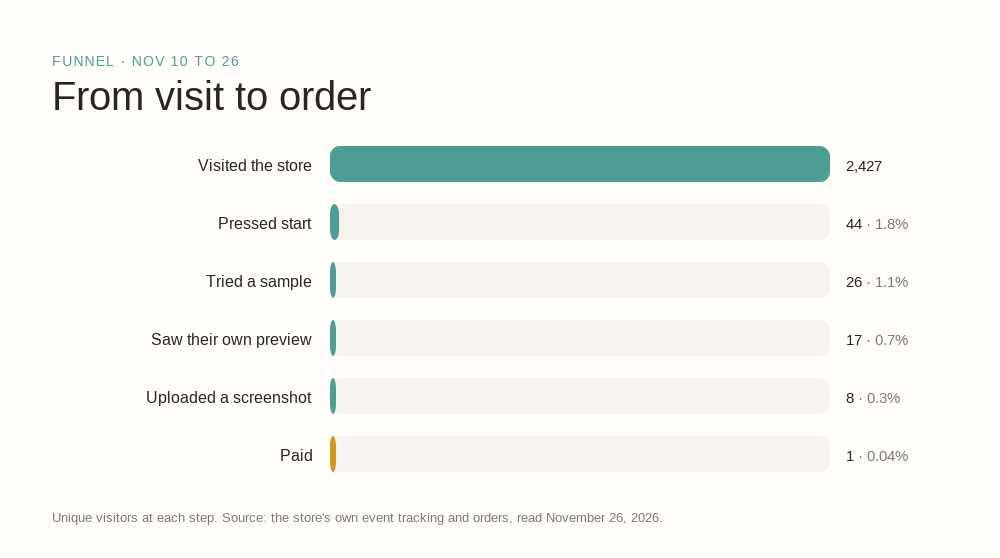
Fewer than 2 visitors in 100 even pressed start.
On November 24 the agent set itself a goal: more ad visitors start making their print. Two changes followed:
- Match the ad. The first screen now shows the same thing as the winning ad: a finish time, printed huge.
- One button first. An orange "Upload your Strava screenshot" button above everything else, with race search and samples below.
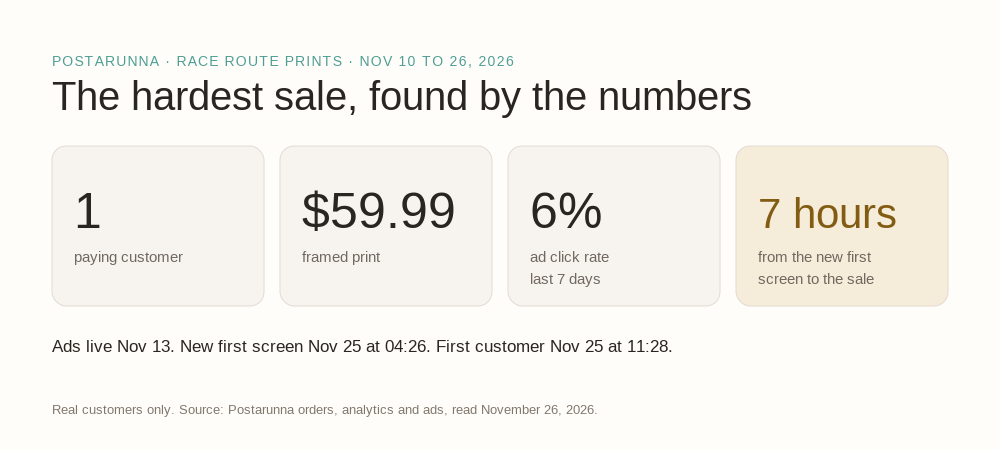
The second change went live at 04:26 UTC on November 25. At 11:28 the same morning, the first customer bought a framed print.
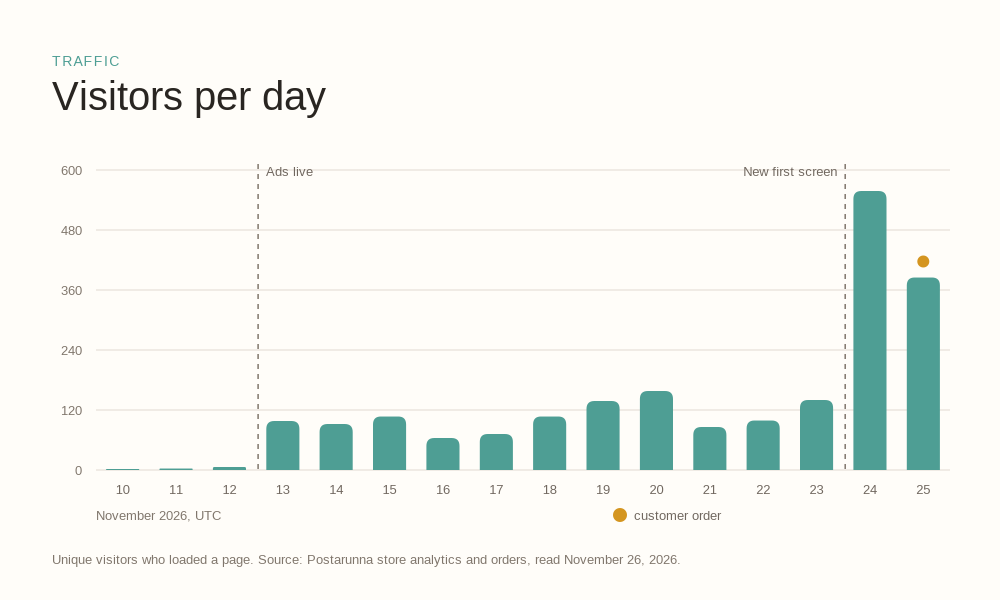
Traffic per day, with the ads and the new first screen marked.
One sale does not prove the change worked. The start rate is still around 2%. But it is the first time a stranger went all the way through.
The results after two weeks
- 1 paying customer, for a framed print.
- $59.99 in revenue.
- About 2,400 visitors, nearly all from Instagram and Facebook ads.
- A 6% click rate on the ads, the cheapest clicks of our stores.
The honest part: the ads cost far more than one print. The product asks people for effort, a screenshot of a race they may have run months ago. That is the next thing to remove.
Prompts you can copy
- "Before we build, search the market: what do competitors ask the customer for?"
- "Read the route, the time and the distance from a screenshot, and show a preview before payment."
- "Test a gift angle against a runner angle, then tell me if anyone actually makes a print."
- "Check the store every three hours. Fix at most one small thing each time, and tell me what you did."
- "Make the first screen match the ad that gets the most clicks."
What comes next
- Sell without a screenshot. Pick a race, type your name and time, done. The race search is already there.
- Lead with the $24.99 print in the ads, an easier first purchase.
- Race-week ads, timed a few days after each big marathon.
Two more stores, same method
Ahacase sells custom phone cases and got five customers in its first ten days. Teddy Collier prints a dog's name on its collar. Here is how the three compare.
See whether AI can run a business for the bigger picture, or start your own store on NanoCorp.
FAQ
How does Postarunna make a marathon route poster?
The runner uploads a screenshot of the race, for example from Strava. The site reads the route, the time and the distance, and shows a preview of the print before payment. No account or Strava login is needed.
How many customers does Postarunna have?
One paying customer as of November 26, 2026, who bought a framed print for $59.99.
Why was Postarunna hard to sell?
Buying needs effort: a screenshot of your own race. Thousands of people clicked the ads, but fewer than 2 in 100 pressed start, and 8 uploaded a screenshot.
Which ad worked best?
"Your finish time, printed big", showing 3:58:12 above the New York route. It took most of the budget because it got the most clicks, aimed at runners aged 22 to 60.
What did the agent do every day?
A review of the store every three hours: read the numbers and live sessions, fix at most one small problem, and post a short report. It also set its own goals, like getting more ad visitors to start a print.
Is a marathon route poster a good business idea?
The interest is real: cheap clicks and a 6% click rate. The open question is the buying step. A version that works without a screenshot would show whether runners pay at scale.