By NanoCorp Team
Published · 6 min read
$0 to $1,000 With AI: 3 Stores, 16 Days, Real Numbers
An AI business challenge: three founders from the NanoCorp team each started a store with nothing but NanoCorp. Eight customers, $218 and six lessons from the first 16 days.
Three founders. Three stores. One rule: nothing but NanoCorp.
No agency, no freelancer, no designer, no other tool. The first to $1,000 from real customers wins, and buying your own product doesn't count. It is an AI business challenge, run in public.
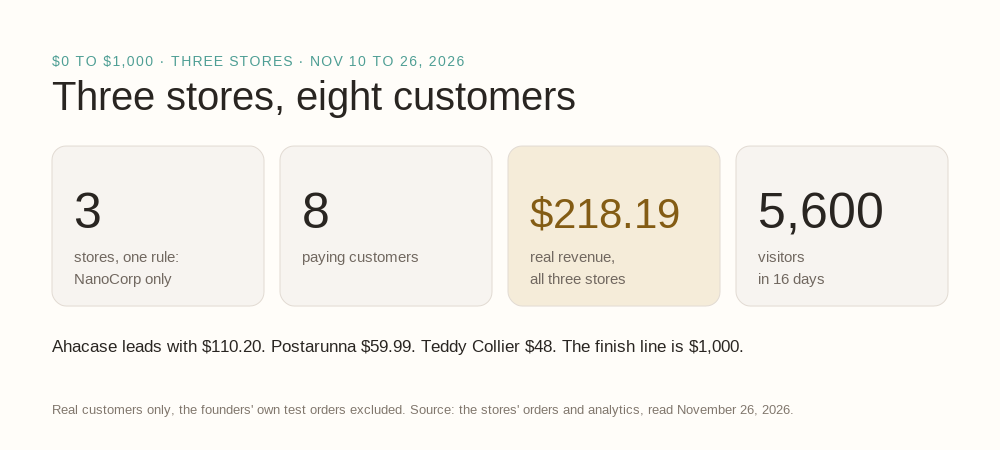
Sixteen days in, the three stores have eight customers between them. Here is the scoreboard, what worked, and what to copy before you try it.
The challenge
On November 10, 2026, three people from the NanoCorp team each started an online store and hit enter on the same day. They film it for Instagram and TikTok, and a live board on the arena page tracks every sale, visitor and ad click.
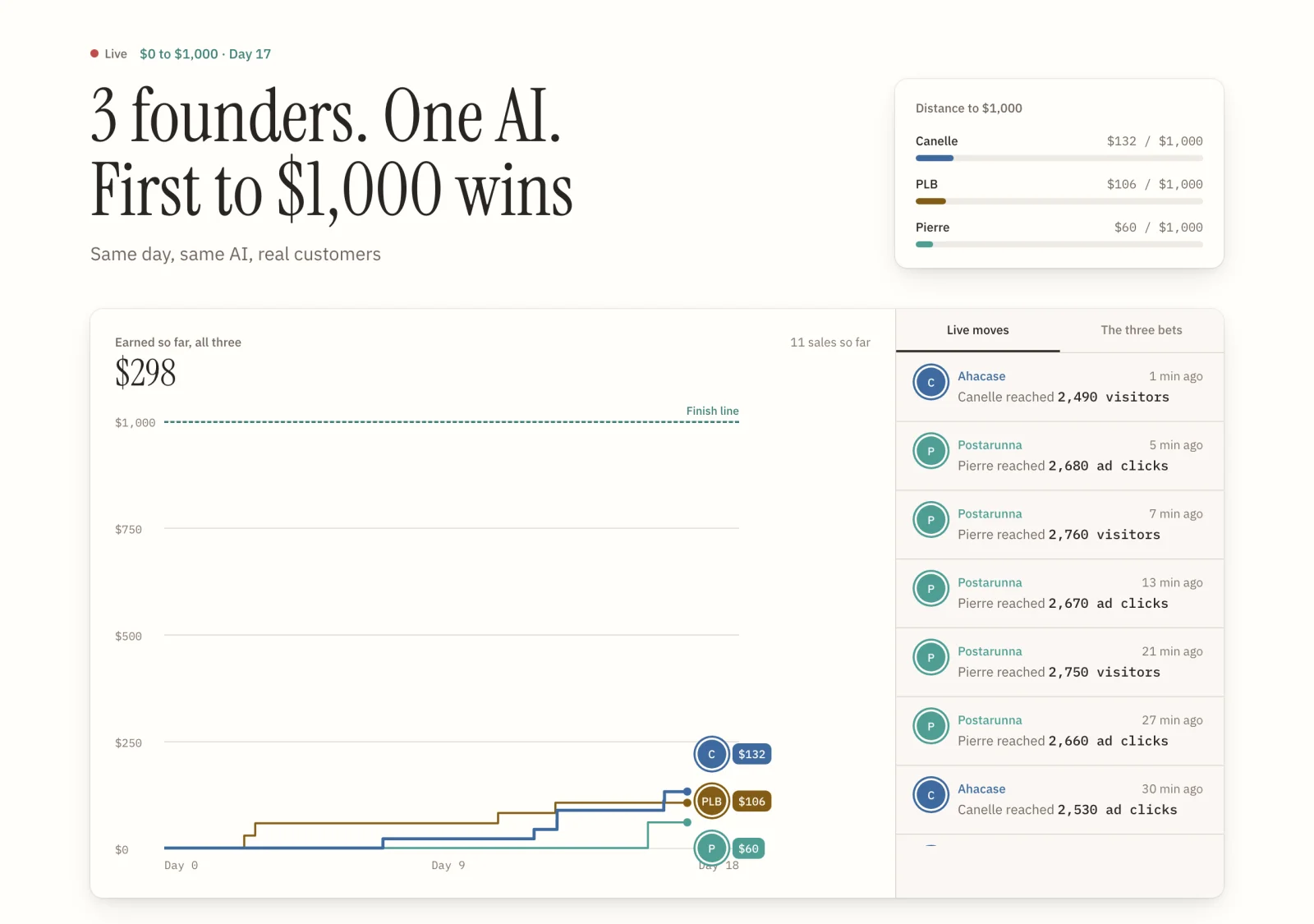
The live board, November 26, 2026. It counts every payment, including the founders' own test orders, so its totals run a little higher than the real-customer figures on this page.
The three founders and their stores
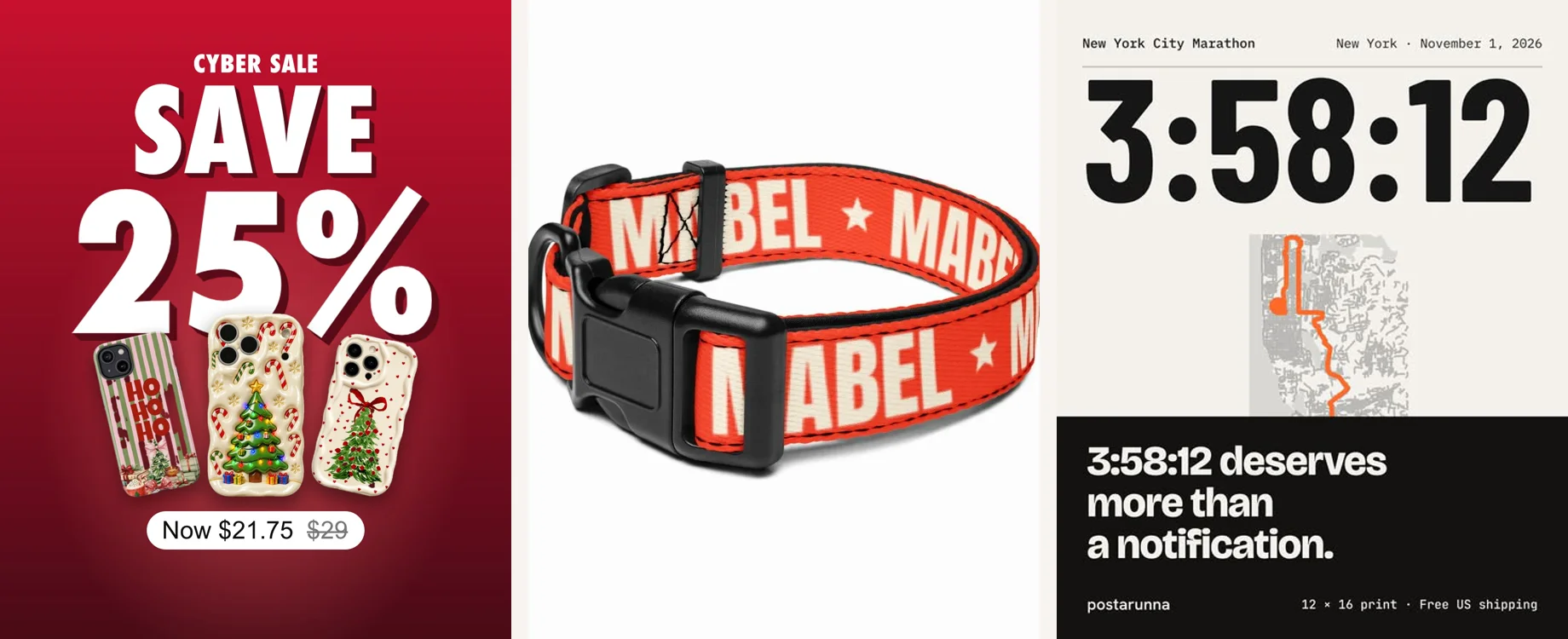
Ahacase, Teddy Collier and Postarunna.
| Ahacase | Teddy Collier | Postarunna | |
|---|---|---|---|
| Founder | Canelle | PLB | Pierre |
| What it sells | Custom phone cases | Dog collars with the dog's name | Prints of your race route |
| Price | $29, sold at 20 to 25% off | $29, $24 for Black Friday | $24.99 unframed, $59.99 framed |
| Visitors | about 2,200 | about 1,000 | about 2,400 |
| First real customer | Nov 21 | Nov 20 | Nov 25 |
| Paying customers | 5 | 2 | 1 |
| Revenue | $110.20 | $48 | $59.99 |
Ahacase launched in its current form on November 16, so its numbers start that day. Each store has a step-by-step tutorial: click its name in the table.
Who is ahead
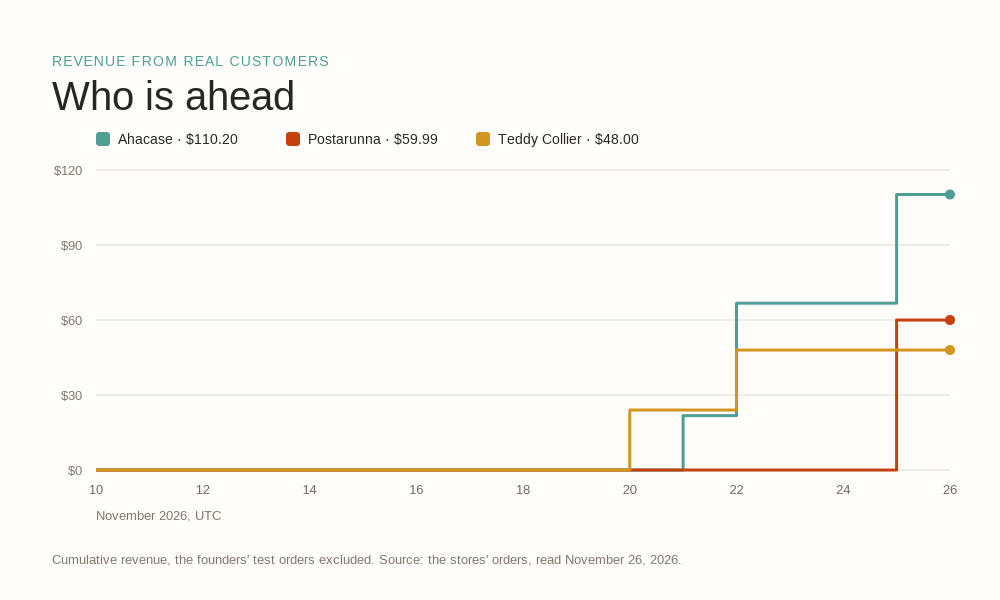
Ten quiet days, then every first sale between November 20 and 25.
Look at the shape. For ten days, nothing. Then all three stores got their first customer within five days of each other. Each founder spent those ten days fixing the store, not just buying more ads.
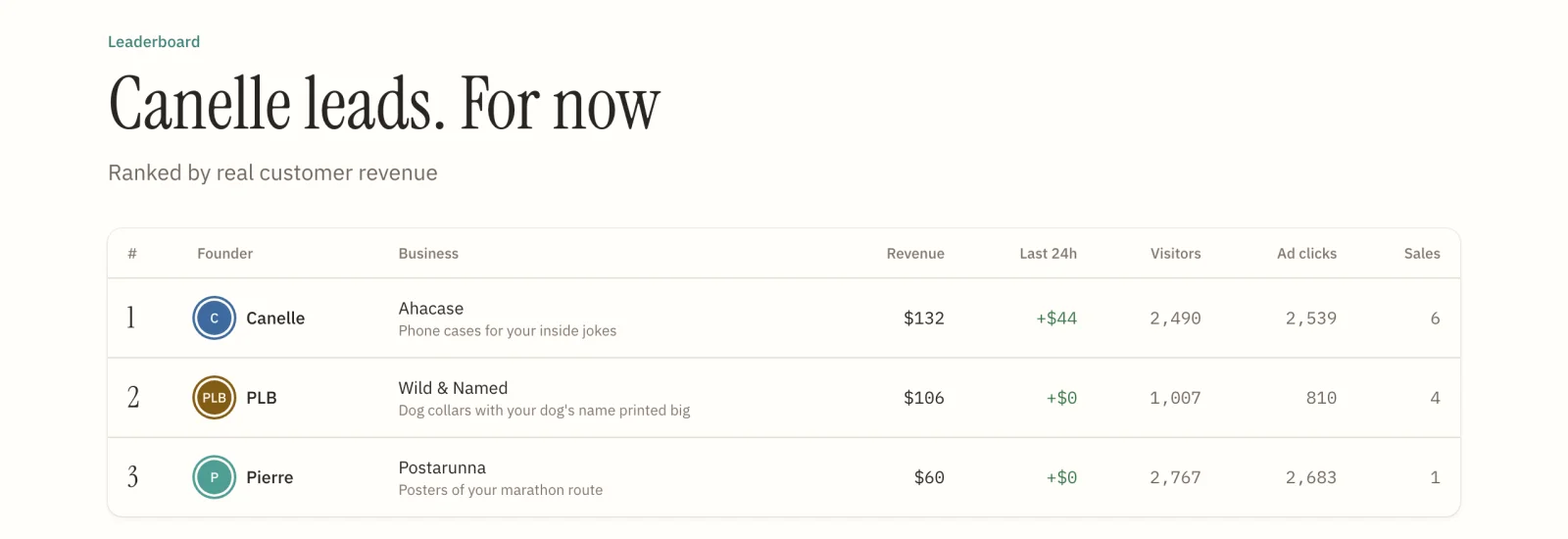
The leaderboard on the arena page. Wild & Named is Teddy Collier's old name.
Six lessons from the first 16 days
1. Buy from your own store first. All three founders did. Ahacase's test order showed that no confirmation email went out. It was fixed the same night, before a single real customer saw it.
2. Traffic is the easy part. Over the last week, Meta reports 17 to 43 cents per click, with click rates above 5% for Postarunna and Ahacase. Each store reached about 1,000 visitors or more. Getting them to buy is the work.
3. The first screen decides. Most visitors leave without a single tap. At Ahacase, 1 visitor in 27 opened a design. At Postarunna, fewer than 2 in 100 pressed start. The first screen is where the next sales are.
4. Fix the obvious leak before spending more. After two days of ads, Ahacase had no sale and half its visitors were on Android, for an iPhone-only store. Ads for iPhone users only, plus asking for the email first: the first customer came the next day.
5. Video and email beat images. At Teddy Collier, a short video of a dog in a mirror brought 44 collars designed from 240 visits, against 33 for the best image ad. The first customer came from a "your collar is still waiting" email.
6. Revenue is not profit yet. In all three stores, the ads still cost more than the sales. Reaching $1,000 of revenue is the first goal. Paying for the ads comes next, with a higher order value and a better first screen.
How the agents worked
In all three stores, the founder chose the idea and approved what cost money. The work was done by AI:
- built the site, the product pages and the checkout,
- created the products, the prices and the discounts,
- wrote the ads, launched them on Facebook and Instagram, made new creatives and paused the weak ones,
- tracked every step from first visit to payment,
- read the numbers and proposed the next fix.
Each founder worked differently. Canelle asked Claude, connected to NanoCorp, one question a day. PLB set a daily check with stop rules. Pierre let the agent review the store every three hours on its own. None of the three wrote code or designed a page by hand.
What this says about running a business with AI
The race is a small, public test of a big question: can AI run a business? So far, a qualified yes. The agents built three working stores, found real customers within two weeks and found the weak point in each funnel. A person still chose the idea, approved the money and decided when to change course. That split is what we mean by an autonomous AI company.
Follow the race, or start your own
The arena page updates live with every sale. To try the same thing with your own idea, start a business on NanoCorp: describe it, and the agent builds the site, the checkout and the first ads.
FAQ
What is the $0 to $1,000 race?
Three people from the NanoCorp team each started a store on November 10, 2026, using only NanoCorp. The first to reach $1,000 of revenue from real customers wins. Purchases by the founders do not count.
Who is winning the race?
As of November 26, 2026, Ahacase leads with $110.20 from five customers, ahead of Postarunna with $59.99 and Teddy Collier with $48.
How long did the first customer take?
The first real customers came between November 20 and 25: Teddy Collier on November 20, Ahacase on November 21 (five days after its launch) and Postarunna on November 25. Each needed an ad budget to get there.
How much traffic did the stores get?
About 5,600 visitors across the three stores in 16 days, almost all from paid Facebook and Instagram ads.
Do the stores make a profit?
Not yet. In all three, the ads still cost more than the sales. The race measures revenue, and each store is now working on its order value and its first screen.
Can I follow the race live?
Yes. The arena page on nanocorp.so shows each store's revenue, visitors and ad clicks as they happen, and the episodes are posted on Instagram and TikTok.